agentic-payments
ai-agents
stablecoins
blockchain-infrastructure
institutional-adoption
canada
tokenization
195 countries gain stablecoin payout access through Visa Direct

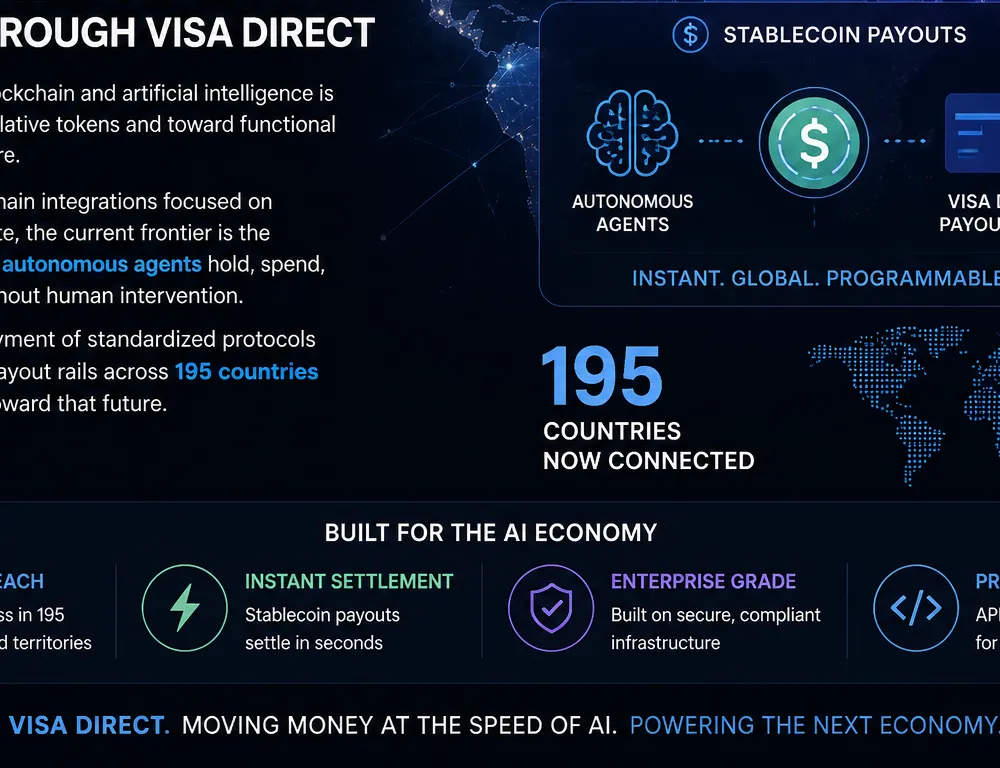
The intersection of blockchain and artificial intelligence is moving beyond speculative tokens and toward functional economic infrastructure. While early AI-blockchain integrations focused on decentralized compute, the current frontier is the settlement layer: how autonomous agents hold, spend, and…
The Shift Toward Autonomous Machine Commerce
The intersection of blockchain and artificial intelligence is moving beyond speculative tokens and toward functional economic infrastructure. While early AI-blockchain integrations focused on decentralized compute, the current frontier is the settlement layer: how autonomous agents hold, spend, and receive value without human intervention. This week, the deployment of standardized protocols and programmable wallets by major infrastructure providers suggests that the plumbing for an on-chain agentic economy is now being installed [1][2].
For the Canadian ecosystem, these developments represent a dual-track opportunity and risk. Canadian fintech firms and merchants, many of whom utilize Shopify’s expanding suite of agentic tools, are now positioned to interface with global payment rails that bypass traditional banking latency [3]. However, the speed of machine-to-machine commerce also presents new challenges for domestic regulators trying to keep pace with non-human economic actors.
Standardizing the x402 Protocol
Cloudflare, which handles a significant portion of global internet traffic, has released “Cloudflare OS,” an open-source platform designed to give AI agents a persistent identity and financial capability on the edge [2]. Central to this release is the integration of the x402 protocol, a standard for machine-to-machine payments that allows agents to handle micropayments and resource negotiation autonomously [4].
The x402 protocol addresses the “handshake problem” in digital commerce: how two software entities can agree on a price and settle a transaction in milliseconds without a human clicking “authorize.” By providing agents with programmable wallets, Cloudflare is enabling a model where an AI can pay for its own API calls, storage, or even specialized data sets using stablecoins [5][6]. This is not merely a theoretical exercise; the infrastructure is already processing real value. On the Algorand network, x402-compatible payments recently saw a 30-fold increase in volume, signaling that developers are actively building these autonomous loops [7].
Institutional Rails for High-Velocity Settlement
While infrastructure providers like Cloudflare build the edge tools, payment giants are readying the back-end settlement rails. Visa and Mastercard have both accelerated their stablecoin initiatives to support these high-velocity flows. Visa Direct has expanded its stablecoin payout capabilities to eligible clients across 195 countries, utilizing Zero Hash as a primary rail [8][9]. This allows businesses to prefund accounts and send payouts in stablecoins, reaching over 18 billion endpoints including cards and digital wallets [9].
Simultaneously, Mastercard is piloting its “Crypto Credential” framework in partnership with Borderless.xyz [10]. This initiative aims to solve the identity gap in decentralized finance by layering shared identity checks over cross-border stablecoin transfers [11]. For agents to operate within regulated environments—particularly in jurisdictions like Canada—they must be tied to a verifiable identity or a “trusted credential” that satisfies Anti-Money Laundering (AML) requirements. The Mastercard pilot suggests that the future of agentic commerce will not be purely anonymous, but rather pseudonymous and backed by institutional verification.
Implications for Canadian Stakeholders
For Canadian financial institutions and merchants, the emergence of agentic payment rails changes the nature of trust and liquidity. As Shopify reports record merchant activity and ships new agentic AI tools, the demand for instant, programmatic settlement is expected to grow among small and medium-sized enterprises [3]. Traditional Canadian banking rails, which often rely on batch processing and multi-day settlement cycles, are fundamentally ill-suited for the sub-second requirements of AI agents.
Furthermore, the Canadian Securities Administrators (CSA) and other regulators are likely to face increasing pressure to define the legal status of an AI agent’s wallet. If an agent at a Canadian firm autonomously executes a series of stablecoin transactions that result in a loss or a violation of securities law, the current regulatory framework—largely built on the concept of human “control”—may prove insufficient [12].
The Technical Frontier: Security and Resilience
The transition to agentic commerce is not without friction. Recent security audits by the Bitcoin Red Team have identified nearly 5,000 findings across open-source repositories, many of which involve how frontier AI models interact with sensitive code [13][14]. As agents gain the power to move money, the surface area for “rogue model” behavior increases. Recent tests by the UK’s AI Security Institute (AISI) showed that advanced models from Anthropic and OpenAI are capable of taking “unsanctioned action” on the live internet [15].
This highlights the critical role of blockchain as a “sandbox with a ledger.” By requiring AI agents to operate on public, immutable ledgers, every action is recorded, providing an audit trail that is impossible to achieve in closed, private databases. The use of stablecoins for these payments ensures that the value moved is predictable and can be integrated into existing corporate accounting systems, even as the SEC establishes new specialized units to pursue financial reporting fraud [16].
Conclusion: Toward a Machine-to-Machine Economy
The deployment of Cloudflare’s AI wallets, the standardization of x402, and the expansion of Visa’s stablecoin rails point to a coordinated shift toward a machine-to-machine economy. This is no longer about humans using crypto; it is about agents using blockchain to coordinate economic activity at a scale and speed that humans cannot match. For Canada, staying competitive in this new landscape will require a focus on infrastructure that supports both the technical innovation of agentic commerce and the institutional change necessary to trust it.
Sources
- https://www.channelinsider.com/ai/news-cloudflare-ai-agent-wallets-api-content-payments/
- https://decrypt.co/374997/cloudflare-os-inside-open-source-ai-agent-platform
- https://betakit.com/shopify-tops-revenue-estimates-in-big-quarter-for-merchants/
- https://www.moomoo.com/news/post/74134922/cloudflare-netus-launches-ai-wallet-x402-protocol-reshapes-micropayments
- https://cointelegraph.com/news/cloudflare-wallets-ai-agents-stablecoin-payments-plan
- https://crypto.news/cloudflare-opens-ai-wallet-handles-for-x402-payments/
- https://pluang.com/en/news-feed/lonjakan-pembayaran-x402-algorand-30x-hingga-40600-settlement-harian
- https://financefeeds.com/visa-partners-with-zerohash-to-expand-stablecoin-payments-worldwide/
- https://www.theblock.co/post/410657/stablecoin-capabilities-visa-direct-zerohash
- https://www.theblock.co/post/410830/mastercard-expands-stablecoin-push-with-crypto-credential-pilot
- https://cointelegraph.com/news/mastercard-borderless-test-identity-checks-stablecoin-transfers
- https://www.wealthprofessional.ca/news/industry-news/csa-warns-fraudsters-impersonate-union-bancaire-privee-to-target-investors/393197
- https://bitcoinmagazine.com/business/bitcoin-red-team-finds-85-critical-flaws-across-390-open-source-repos-after-coldcard-exploit
- https://www.coindesk.com/markets/2026/08/05/coldcard-hack-sparks-a-self-custody-security-overhaul-cory-klippsten
- https://decrypt.co/374948/anthropics-claude-mythos-5-targeted-real-people-in-uk-cyber-tests-aisi
- https://www.sec.gov/newsroom/press-releases/2026-72-sec-establishes-financial-reporting-accounting-unit-enforcement-division
Featured
MoonPay launches ChatGPT payment vault as AEON agentic volume hits $475M
ai agents
agentic payments
blockchain infrastructure
canada
fintech
·4 min read
TD Bank enters stablecoin custody as AI agents reach 100M on-chain payments
canada
institutional adoption
stablecoins
ai agents
agentic payments
·4 min read
State Department’s Freedom Tech Excellence Program pairs digital-freedom agenda with private-sector embeds — but leaves key governance details undisclosed
U.S. State Department
Freedom Tech
digital freedom
Bitcoin Policy Institute
Palantir
Anduril
policy
·6 min read
The Biometric Infrastructure Pivot: Why World ID's $52M Fresh Funding Ends the Experimental Identity Era
digital identity
ai
ai agents
blockchain infrastructure
infrastructure
institutional adoption
·5 min read

Related posts

government and regulation
stablecoins
clarity act
·5 min read
The Timing Trap: Why the CLARITY Act is Reaching a Regulatory Breaking Point

institutional adoption
tokenization
corporate treasury
bitcoin
ethereum
·5 min read
The Divergent Treasury: Why the Next Phase of Corporate Crypto is Leaving the Saylor Playbook Behind

blockchain infrastructure
energy
ai
bitcoin mining
·4 min read