The Power Pivot
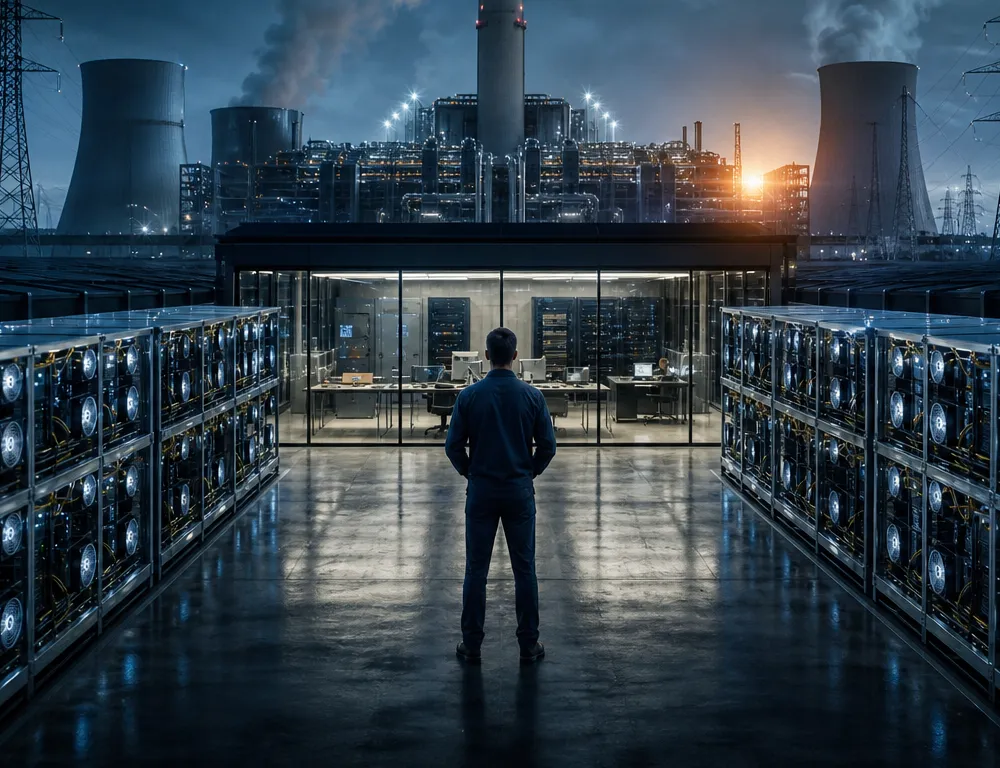
A fundamental shift is occurring in the geography of global compute. For years, bitcoin miners were the primary hunters of stranded energy and high-voltage power capacity. Today, that same infrastructure is being rewired to fuel the artificial intelligence boom.
The Great Migration of Megawatts
A fundamental shift is occurring in the geography of global compute. For years, bitcoin miners were the primary hunters of stranded energy and high-voltage power capacity. Today, that same infrastructure is being rewired to fuel the artificial intelligence boom. The announcement that bitcoin miner TeraWulf (WULF) signed a 20-year lease agreement with AI lab Anthropic is the most significant signal yet of this convergence [7, 13]. The deal, expected to generate $19 billion in revenue over its lifetime, suggests that the competitive advantage of bitcoin miners is no longer just solving hashes—it is the possession of scarce, energized real estate.
As the AI sector faces a critical shortage of data center space and power, the bitcoin mining industry is effectively pivot-mining for ‘AI gold.’ The TeraWulf site in Hawesville, Kentucky, will provide 400 megawatts of IT load to Anthropic, an amount that rivals some of the largest traditional data centers in the world [13]. This movement is being mirrored across the sector; Keel, another firm previously focused on mining, recently hired a veteran from Digital Realty—one of the world’s largest data center REITs—to lead its expansion into the commercial data market [8].
Solving the Power Crisis
The marriage of bitcoin mining and AI represents a logical evolution of digital infrastructure. AI training requires massive, sustained electrical loads, often in the hundreds of megawatts, which traditional utilities struggle to bring online quickly. Bitcoin miners, however, have spent the last decade securing these power pipelines, building substations, and establishing the cooling infrastructure necessary for high-density compute [13].
For miners, the rationale is largely a matter of revenue stability. Bitcoin mining is a volatile, commodity-based business subject to the four-year ‘halving’ cycles that slash production rewards. In contrast, leasing power and space to AI firms provides predictable, multi-year cash flows [7]. This ‘brokerage-as-a-utility’ model allows miners to monetize their hardest asset—power access—regardless of the bitcoin price.
However, this transition is not without friction. Bitcoin mining is ‘interruptible’ load; miners can turn off their machines in seconds during grid stress to sell power back to the grid. AI training, conversely, requires high uptime and consistent cooling. The engineering shift from a flexible mining shed to a Tier 3 data center represents a significant capital expenditure and a different operational philosophy.
The State and the Silicon Grid
Governments and financial institutions are beginning to take note of this infrastructure dual-use. In the United Kingdom, the Financial Conduct Authority (FCA) has warned that the meeting of AI agents and tokenized money will create a financial system with far greater speed and complexity [14, 54]. If the physical infrastructure for both—the ledgers and the agents—sits on the same power grid, the resilience of that grid becomes a matter of national economic security.
Regulators are also looking at how these mega-leases impact local energy markets. In Russia, even as Sberbank moves toward launching digital repositories and crypto wallets by December, the state is concurrently tightening its grip on industrial mining to ensure energy stability [10, 56]. Similarly, the U.S. power grid is under scrutiny as AI and mining compete for the same limited supply of electricity.
A Structural Rebuild
The consolidation of compute power is not occurring in a vacuum. As Vitalik Buterin notes regarding the Ethereum roadmap, the underlying infrastructure of the on-chain economy is being rebuilt for a new era of privacy and quantum safety [45]. If miners continue to exit the hash-production business in favor of AI leasing, the security model of proof-of-work networks may eventually need to compete with the high-margin returns of the Silicon Valley compute market.
For now, the market is rewarding the pivot. Shares in mining firms have surged following news of these AI partnerships, as investors revalue these companies not as fringe speculative plays, but as essential infrastructure providers for the next phase of the digital economy [7]. The distinction between a ‘crypto company’ and a ‘data center company’ is rapidly dissolving.
Sources
- [7] https://decrypt.co/372810/bitcoin-mining-stocks-jump-terawulf-19-billion-lease-anthropic
- [8] https://www.theblock.co/post/407300/keel-jumps-10-former-bitcoin-miner-hires-data-center-veteran-president
- [13] https://www.theblock.co/post/407282/terawulf-data-center-lease-anthropic-19-billion-revenue
- [14] https://cointelegraph.com/news/fca-warns-of-major-shakeup-as-ai-agents-meet-tokenized-money
- [54] https://cointelegraph.com/news/central-bankers-sound-alarms-over-agentic-ai-finance-risks
- [56] https://cointelegraph.com/features/asia-express
Featured
MoonPay launches ChatGPT payment vault as AEON agentic volume hits $475M
ai agents
agentic payments
blockchain infrastructure
canada
fintech
·4 min read
TD Bank enters stablecoin custody as AI agents reach 100M on-chain payments
canada
institutional adoption
stablecoins
ai agents
agentic payments
·4 min read
State Department’s Freedom Tech Excellence Program pairs digital-freedom agenda with private-sector embeds — but leaves key governance details undisclosed
U.S. State Department
Freedom Tech
digital freedom
Bitcoin Policy Institute
Palantir
Anduril
policy
·6 min read
The Biometric Infrastructure Pivot: Why World ID's $52M Fresh Funding Ends the Experimental Identity Era
digital identity
ai
ai agents
blockchain infrastructure
infrastructure
institutional adoption
·5 min read

Related posts

blockchain infrastructure
government and regulation
tokenization
stablecoins
ai
defi
·4 min read
The Emergence of Autonomous Capital

institutional adoption
blockchain infrastructure
tokenization
cross border payments
·3 min read
The Settlement Paradox
institutional adoption
blockchain infrastructure
tokenization
cross border payments
·3 min read