The Livestock Credit Pivot: Why Tokenized Agriculture Ends the Collateral Constraint Era

For decades, the limiting factor for global agricultural expansion has not been land or labor, but the rigidity of the traditional credit appraisal [52]. In emerging markets, particularly Brazil, small and mid-sized farmers frequently hit "lending limits" imposed by commercial banks, regardless of…
For decades, the limiting factor for global agricultural expansion has not been land or labor, but the rigidity of the traditional credit appraisal [52]. In emerging markets, particularly Brazil, small and mid-sized farmers frequently hit “lending limits” imposed by commercial banks, regardless of the health or value of their biological assets [106]. A structural shift is now underway as the industry moves toward the tokenization of livestock, transforming living animals into high-fidelity, on-chain collateral that bypasses legacy banking bottlenecks.
The Data-to-Debt Pipeline
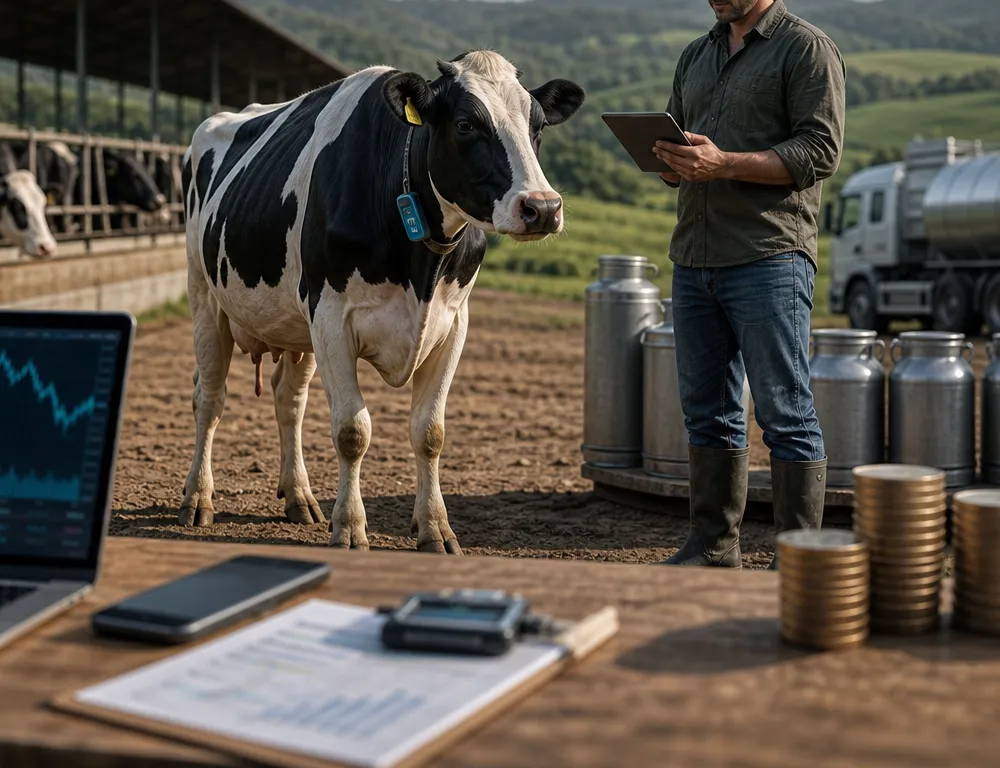
Recent developments in Brazil mark a transition from theoretical blockchain experiments to functional credit markets. Ten tokenized dairy cows recently backed a $19,600 loan registered on B3, Brazil’s primary stock exchange [65]. Unlike previous attempts at agricultural tokenization that relied on manual self-reporting, this new framework utilizes “smart collars” that monitor herd health and location in real time [52].
This integration of Internet of Things (IoT) hardware with blockchain settlement addresses the primary hurdle for agricultural lending: fraud and verification transparency. By providing a continuous data feed, the system allows lenders to prevent the “double-pledging” of assets and ensures the collateral still exists and remains healthy throughout the loan term [52][106]. As one Brazilian report notes, this mechanism offers a lifeline to dairy farmers whose credit access has been stunted by a deepening sector-wide liquidity crisis [106].
Bypassing the Bank Mandate
The pivot toward tokenized livestock represents more than just a new ledger; it is a move toward “narrow credit.” In traditional systems, a bank evaluates a farmer’s total balance sheet, often rejecting loans due to overall debt ratios even if the specific project—such as expanding a dairy herd—is highly solvent. By tokenizing specific cows, farmers can secure financing directly backed by the asset’s productivity, often at rates that compete with or beat traditional bank offerings [52][65].
This model is gaining momentum across North America as well. Companies like BinSentry are building “AI moats” in AgTech, using automated sensors and data models to provide the same level of granular transparency that lenders require for high-risk assets [116]. The goal is to move agricultural credit away from speculative estimates and toward verifiable, real-time metrics [116].
Risks and the Scale Impasse
While the first successful loans on B3 signal a breakthrough, the era of widespread livestock tokenization faces significant hurdles. Critics and analysts warn that while the technology solves the “informational asymmetry” problem, it does not solve the “liquidity problem” for the tokens themselves [115]. If a farmer defaults, the process of liquidating a tokenized cow remains a physical, localized challenge that digital ledgers cannot fully automate.
Furthermore, the cost of the monitoring hardware—the smart collars and sensors required to maintain the “truth” of the token—remains a barrier for the very small-scale farmers who need credit the most [52]. For the industry to move beyond the current pivot and into a mass-market adoption phase, the price of the “verification layer” must fall significantly.
Analysis: The End of Static Collateral
This shift suggests that we are entering a period where collateral is no longer a static entry on a spreadsheet but a dynamic, data-rich stream. The success of the Brazilian pilot indicates that regulators and traditional stock exchanges like B3 are becoming comfortable with biological assets living on-chain [65]. For investors, this creates a new asset class: yield backed by the literal productivity of global food supply chains.
As tokenization moves from “tokenized stocks” to “tokenized cows,” the focus of the blockchain industry is shifting toward real-world assets (RWA) that exhibit low correlation with the broader crypto market [115]. The livestock credit pivot is the first clear evidence that when traditional banks stop lending, the blockchain does not just provide a new currency—it provides a new way to prove value.
Sources
- https://www.coindesk.com/markets/2026/07/24/brazilian-farmers-tokenized-dairy-cows-to-get-loans-bypassing-bank-lending-limits
- https://cointelegraph.com/news/brazils-b3-rwa-credit-tokenized-cows-collateral
- https://decrypt.co/374148/brazilian-farmers-cows-blockchain-loans
- https://betakit.com/how-binsentry-built-an-ai-moat-in-agtech
- https://www.coindesk.com/coindesk-indices/2026/07/23/crypto-for-advisors-it-s-time-for-tokenization-to-get-to-work
Featured
MoonPay launches ChatGPT payment vault as AEON agentic volume hits $475M
ai agents
agentic payments
blockchain infrastructure
canada
fintech
·4 min read
TD Bank enters stablecoin custody as AI agents reach 100M on-chain payments
canada
institutional adoption
stablecoins
ai agents
agentic payments
·4 min read
State Department’s Freedom Tech Excellence Program pairs digital-freedom agenda with private-sector embeds — but leaves key governance details undisclosed
U.S. State Department
Freedom Tech
digital freedom
Bitcoin Policy Institute
Palantir
Anduril
policy
·6 min read
The Biometric Infrastructure Pivot: Why World ID's $52M Fresh Funding Ends the Experimental Identity Era
digital identity
ai
ai agents
blockchain infrastructure
infrastructure
institutional adoption
·5 min read